

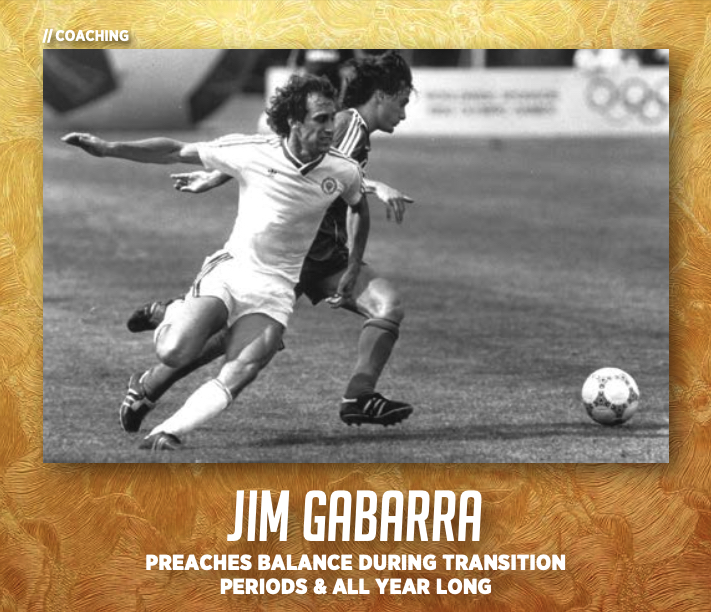
{SJ Editor: Hal Philips recently published “Generation Zero: Founding Fathers, Hidden Histories & the Making of Soccer in America.” This is an example of what you will read in the book. Highly recommended!
By HAL PHILLIPS
When Jim Gabarra competed at the highest levels of American soccer—and he did so both indoors and outdoors—players and coaches gave little thought to their transitions from one setting to the other, and back again. What’s more, during the late 1980s and early 1990s, the challenges facing Gabarra’s teammates on the U.S. Men’s National Team and the U.S. National Futsal side had little to do with overuse. Quite the opposite: With no proper first division operating outdoors, with indoor clubs fending off financial collapse at every turn, the main concern was getting enough matches and training from month to month. For elite, thoroughly underemployed female players at this time, the severity of those issues was likely doubled or trebled.
Gabarra sees the exact opposite situation in 2023: There is so much opportunity to play soccer today—at every age group and skill level: in club, premier, academy and school environ- ments—many believe the primary danger to young players is overuse, especially during those transition periods between indoor and outdoor seasons.
“It’s really difficult to achieve, but I believe the goal for coaches has to be balance—in terms of their own expectations of players, in terms of helping individual young men and women balance their own commitments,” says Gabarra, who spent two-plus decades coaching in the women’s professional ranks after retiring in 1996. Today he works for Pelota, a supplemental technical training service (www.pelotatraining. com) co-owned by his son, Tyler.
“The most important issue in our game today, at the developmental level, is overuse. We are demanding too much of players, especially at younger ages. The most prominentexample is a kid playing two games a week and training with his or her high school team, while also training with a club team—basically, trying to be committed to two teams at the same time. But this issue comes in so many shapes sand sizes.”
Gabarra recognizes these situations are further complicated by the competing agendas that come with our more mature soccer ecosystem: the often-fractured working relationships between club and high school coaches, for example. Or parents pushing kids in pursuit of adult goals, their own returns on investment (read: college scholarships).
“The bottom line is, coaches need to be more open to limiting their own time demands; they need to make the most of their time with players and let kids learn from whatever form of the game they’re playing at the time,” Gabarra argues. “Each player is different and that transition from outdoor to indoor—or from another soccer team, even another sport—is going to vary for each one of them. And maybe this kid who’s just finished a high school season just needs a week off. He or she can come to training and be part of the team, but you probably shouldn’t be grinding that kid with fitness testing and double sessions like the kid who’s just had a month off.
“I believe it’s important for coaches to have that understanding of transition periods, and what the indoor game does for outdoor players, and vice versa. I think a lot of coaches have figured this out because they’ve had to. I don’t like the stories of kids who can’t play high school soccer or other sports. I believe everyone has good intentions, but I don’t agree with the reasoning. I don’t think a truly elite U.S. soccer athlete is going to be a three-sport kid in a high school setting. But maybe 98% of those high school kids can and should play indoor/futsal and other sports.
“Parents, kids, and coaches all need to find the middle ground, the balance. Playing multiple sports trains the body and mind in different ways. There are so many benefits—and this applies to those transition periods, too. I think almost every coach will run a segment of training with a handball session—or kickball or basketball or soccer volleyball—to accommodate that change of environment. Because it’s differential—and not so intensive. And it promotes growth in players physically, emotionally, even tactically.”
Specialization Seeps into Non-Elite Player Pool
Overuse issues in 2023 are inextricably tied to the dedication issue. Today, it’s accepted as conventional wisdom that players are better off concentrating on soccer 10 months a year, to the exclusion of other sporting pursuits. Yet if that sort of option is only practical for true elites—a population Gabarra pegs at maybe 2-4% of 16 year-olds—to what exactly are all these kids really dedicating themselves?
Back in the 1980s and ’90s, when year-round, for-profit premier programs and MLS- or Federation-affiliated academies did not exist, no one thought twice about playing multiple sports, or spending a winter indoor/futsal season on either side of an outdoor campaign. What’s more, questions about the developmental utility of indoor soccer were perhaps more open to debate.
When Gabarra turned pro in 1982, the North American Soccer League was teetering on the brink. When it did fold, in November 1984, the entire outdoor professional infrastructure collapsed. I write about this pivotal moment and its manifold effects on U.S. soccer culture in my new book, Generation Zero: Founding Fathers, Hidden Histories & The Making of Soccer in America (Dickinson-Moses Press, 2022).
Because NASL was gone, the 1985 U.S. Men’s National Team, for example, was stocked almost exclusively with indoor players—because the Major Indoor Soccer League had not folded (not yet). In May 1985, when that national team crashed out of World Cup qualifying, many—including future USMNT captain Mike Windischmann—blamed the indoor game for degrading the outdoor skills of an entire generation of U.S. players.
“Yeah, I read that in your book, and I understand where Mike is coming from,” Gabarra says. “But I don’t think there is an exclusively wrong way or a right way to train players. Yes, it takes a little while to adjust to the outdoor game after an indoor season. You don’t want guys flying straight from an MISL playoff situation to an outdoor qualifier, as we did [prior to the Olympics] back in 1987. But a lot of what I saw then, and what I see today, is the demonstrable value in playing different forms of soccer. Purely from a tactical perspective, the indoor game creates 200 times the decision-making challenges. For me, it’s always been about taking the best from both, achieving that balance.
“But then, when it came to soccer, I’ve always been an outlier.”
A Self-taught Boomer among GenXers
The man makes as fair point: Born in 1959, Gabarra is a Baby Boomer, whereas all his national team colleagues in 1989-90 were GenX, born in 1963 or later. These relative youngsters were all introduced to soccer at early ages, during the Youth Soccer Revolution of the 1970s. Not Gabarra. He didn’t touch
a soccer ball until he was 13. While Windischmann and his contemporaries were all products of the Olympic Development Program and Division I college soccer, Gabarra arrived at D3 Connecticut College the year ODP was founded (1978). Upon graduation, he went straight to the pro indoor game via open tryouts—not NASL, not even the more established MISL, but rather the rival American Indoor Soccer Association.
I interviewed a dozen different members of the 1990 USMNT for Generation Zero, but I didn’t speak to Gabarra—because I worked backward from the final World Cup roster, and Gabarra had been one of coach Bob Gansler’s final cuts. Still, the outlying Gabarra appeared 14 times for the USMNT (19 if we count 1988 Olympic qualifiers), all between 1987-89, and he captained the U.S. National Futsal Team from 1986 until his retirement in 1996. From there he went straight into coaching, first in the old Continental Indoor Soccer League, then out of doors—in the women’s professional game. Gabarra is surely the only person to coach in all three iterations of women’s pro soccer in this country. His last gig, with the NWSL’s Washing- ton Spirit, concluded in the spring of 2018.
“It’s been a very nomadic but pleasing life. Decisions had to be made along the way, and not always by choice,” says Gabarra. “When I graduated college, if you wanted to play professionally, that meant playing indoor, as NASL opportunities were very limited for U.S. players. Then NASL went away and it became the same for everyone, whether they preferred the outdoor game or not. Every two or three years, the team or the league would fold. So, you were out there looking for the next opportunity, to keep playing. My coaching career has been a similar journey.
“I try to explain to my son and my students how different it is for American kids today. Yes, there is the danger of overuse. But getting to your professional potential, as a player, is a process—a four- to five-year investment of time and grit. And during that time, you’re likely going to hear no, a lot. Every coach has an opinion. But today, players need to understand that if one coach doesn’t like or prefer you as a player, someone else will feel differently.”
Academy Model puts Everyone in Difficult Positions
In finessing that transition from outdoor to indoor, it’s more important how often coaches manage to say yes. According to Gabarra, the moment a player gets the impression a coach isn’t fully invested in that kid’s development journey, the jig is up. Unfortunately, today’s premier and academy models—specifically, the capitalist imperatives underpinning those models—put coaches, players and parents in some very difficult positions.
“The business side of it has really distorted our game in a lot of ways,” Gabarra asserts. “It’s hard nowadays to know when and how kids and coaches should diversify training. That’s where most of the world has it right: The parents aren’t paying for that [academy training] and, as a result, parents don’t say boo. But you can’t call your parents and tell them to back off when they’re your customers! In my opinion, if you call yourself elite or academy with a path to pro, those kids shouldn’t be paying a dime.”
Some may accuse him of bias, but Gabarra sees a ton of transitional utility in futsal, no matter how or where winter season matches are contested.
“The transition to indoor can and should protect players by concentrating on the aspects of indoor that serve everyone’s development. Fitness levels are different; that transition requires time. But if the game is faster, the spaces are smaller? For me, that means the player is making hundreds of times more decisions per game, per training session. Those increased reps and decision-making? I don’t see a downside there. Futsal is just a far more technical environment, less physical. It’s really sort of perfect for developing all players. And for high school teams, it’s far more practical: You’re not relying on a rink with boards. You can go play in the gym.
“If you compare passing patterns for the outdoor game to futsal pattern play, there are certainly differences—both in number and shape. I believe in outdoor soccer: The patterns there are a little more linear. In futsal there is more circulation, faster circulation in tighter spaces. Both, in my opinion, provide a positive developmental environment.”
Gabarra also sees a lot of commonalities between the work he does at Pelota and the sort of sessions that make sense for these shoulder periods between seasons.
“I try to cover multiple skills in a session: You’ve got dribbling, prep touches, half turns, passing, finishing, defending, heading—things that U.S. players haven’t been trained to do
in a detailed way, to be honest. But if you can cover a bit of everything, the kid gets hundreds of hundreds of touches. With supplemental training, I always make sure it’s position specific, as well.
“But there’s no reason coaches can’t apply the same method- ology in their training environments, in short spells: one hour, maybe twice a week. And that’s yet another way to program your transition week for kids coming off a club or high school season.”
Leave A Comment